
Global Breaking News - Monday, October 12, 2026








   |
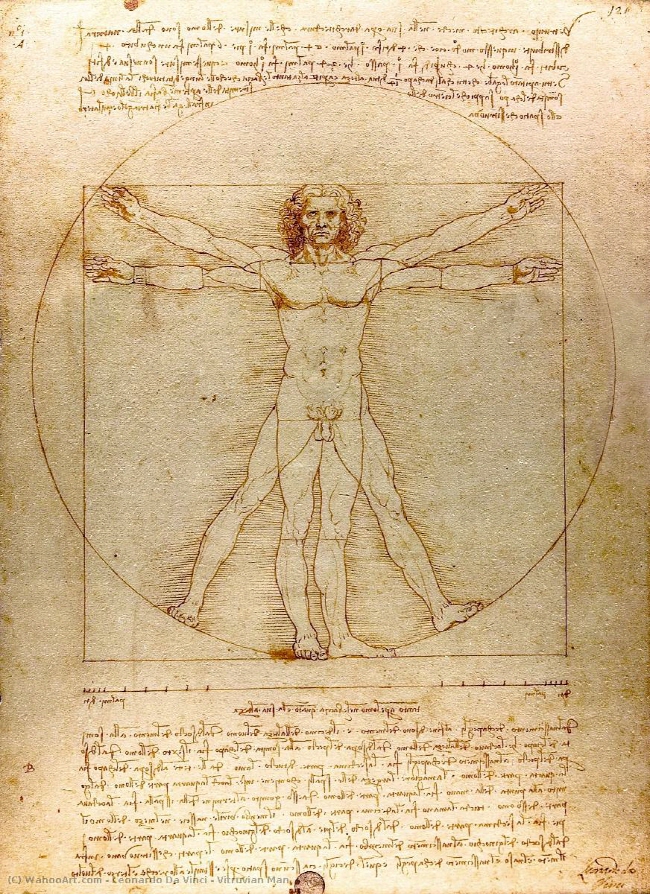
[Misc] (Top 100 Paintings - 053) Vitruvian Man by Leonardo Da Vinci
최고관리자 | 20-10-09 23:22
(1) "Write 2 Speak 전체 목록 & 모든 콘텐츠"를 보시려면 "Write 2 Speak = 유튜브 채널"에
가입(subscribe - 클릭)후 "본인의 유튜브 ID & Write2Speak 등록 ID"를 "write2speak@daum.net"로
이메일로 보내 주시면 확인 후 본 사이트 정회원으로 등급됩니다. 많은 신청 기다리겠습니다.
(2) 참고로, "Write 2 Speak"에 올라오는 유튜브 contents는 정기적으로 삭제가 되며, "전체 내용"을 보시려면
위에 절차를 따라야만 "Write 2 Speak -> 자료실(클릭)"영역에서 모든 내용을 다시 볼 수 있습니다.
****************************************************************************************
Vitruvian Man by Leonardo Da Vinci
The Vitruvian Man (Italian: L'uomo vitruviano [ˈlwɔːmo vitruˈvjaːno]; originally known as Le proporzioni del corpo umano secondo Vitruvio, lit. 'The proportions of the human body according to Vitruvius') is a drawing made by the Italian polymath Leonardo da Vinci in about 1490. It is accompanied by notes based on the work of the Roman architect Vitruvius. The drawing, which is in ink on paper, depicts a man in two superimposed positions with his arms and legs apart and inscribed in a circle and square. It is kept in the Gabinetto dei disegni e delle stampe of the Gallerie dell'Accademia, in Venice, Italy, under reference 228. Like most works on paper, it is displayed to the public only occasionally, so it is not part of the normal exhibition of the museum. The work was recently on display at the Louvre's exhibit of Da Vinci's work, from 24 October 2019 to 24 February 2020 as part of an agreement between France and Italy.
The drawing represents ideal human body proportions. Its inscription in a square and a circle comes from a description by the ancient Roman architect Vitruvius in Book III of his treatise De architectura. Yet, as it has been demonstrated, Leonardo did not represent Vitruvius's proportions of the limbs but rather included those he found himself after measuring male models in Milan. While the drawing is named after Vitruvius, some scholars today question the appropriateness of such a title.
First published in reproduction in 1810, the drawing did not attain its present fame until further reproduced in the later 19th century, and it is not clear that it influenced artistic practice in Leonardo's day or later.
|
|