
Global Breaking News - Monday, October 12, 2026








   |
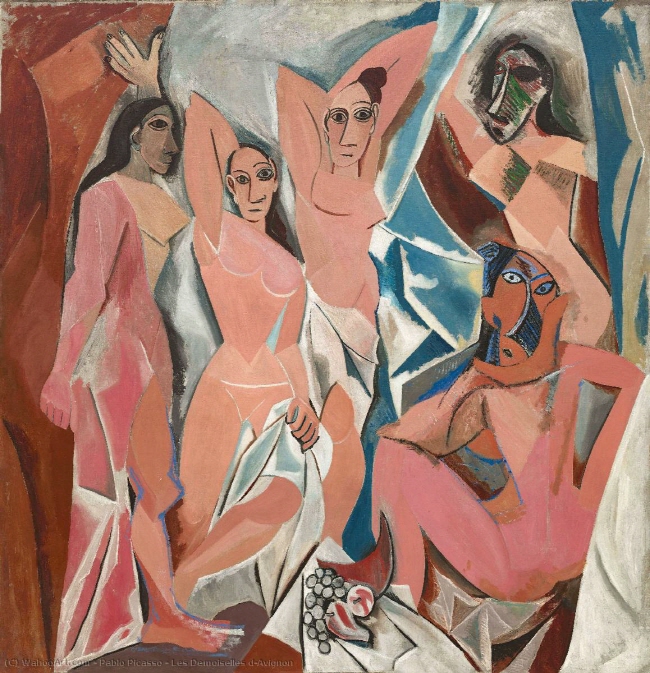
[Misc] (Top 100 Paintings - 017) Les Demoiselles d'Avignon by Pablo Picasso
최고관리자 | 20-01-30 23:45
(1) "Write 2 Speak 전체 목록 & 모든 콘텐츠"를 보시려면 "Write 2 Speak = 유튜브 채널"에
가입(subscribe - 클릭)후 "본인의 유튜브 ID & Write2Speak 등록 ID"를 "write2speak@daum.net"로
이메일로 보내 주시면 확인 후 본 사이트 정회원으로 등급됩니다. 많은 신청 기다리겠습니다.
(2) 참고로, "Write 2 Speak"에 올라오는 유튜브 contents는 정기적으로 삭제가 되며, "전체 내용"을 보시려면
위에 절차를 따라야만 "Write 2 Speak -> 자료실(클릭)"영역에서 모든 내용을 다시 볼 수 있습니다.
****************************************************************************************
Les Demoiselles d'Avignon by Pablo Picasso
Les Demoiselles d'Avignon (The Young Ladies of Avignon, and originally titled The Brothel of Avignon) is a large oil painting created in 1907 by the Spanish artist Pablo Picasso (1881–1973). The work portrays five nude female prostitutesfrom a brothel on Carrer d'Avinyó (Avinyó Street) in Barcelona. Each figure is depicted in a disconcerting confrontational manner and none are conventionally feminine. The women appear as slightly menacing and rendered with angular and disjointed body shapes. Two are shown with African mask-like faces and three more with faces in the Iberian style of Picasso's native Spain, giving them a savage aura. In this adaptation of Primitivism and abandonment of perspective in favor of a flat, two-dimensional picture plane, Picasso makes a radical departure from traditional European painting. The work is widely considered to be seminal in the early development of both cubism and modern art. Demoiselles was revolutionary and controversial, and led to wide anger and disagreement, even amongst his closest associates and friends.
Painted in Paris during the summer of 1907, Picasso had created hundreds of sketches and studies in preparation for the final work. He long acknowledged the importance of Spanish art and Iberian sculpture as influences on the painting. The work is believed by critics to be influenced by African tribal masks and the art of Oceania, although Picasso denied the connection many art historians remain skeptical about his denials. Several experts maintain that, at the very least, Picasso visited the Musée d'Ethnographie du Trocadéro (known today as Musée de l'Homme) in the spring of 1907 where he saw and was unconsciously influenced by African and Tribal art several months before completing Demoiselles. Some critics argue that the painting was a reaction to Henri Matisse's Le bonheur de vivre and Blue Nude.
Its resemblance to Cézanne's Les Grandes Baigneuses, Paul Gauguin's statue Oviri and El Greco's Opening of the Fifth Seal has been widely discussed by later critics. At the time of its first exhibition in 1916, the painting was deemed immoral. In the nine years after its creation, Picasso had always referred to it as Le Bordel d'Avignon, but art critic André Salmon, who managed its first exposition, retitled it Les Demoiselles d'Avignon to lessen its scandalous impact on the public. Picasso never liked Salmon's title, and as an edulcoration would have preferred las chicas de Avignon instead.
|
|