
Global Breaking News - Monday, October 12, 2026








   |
[Headlines] (HL-예술/취미/종교) Sky Watchers Prepare For the 'Super Bowl' of Moons
최고관리자 | 18-01-31 20:57
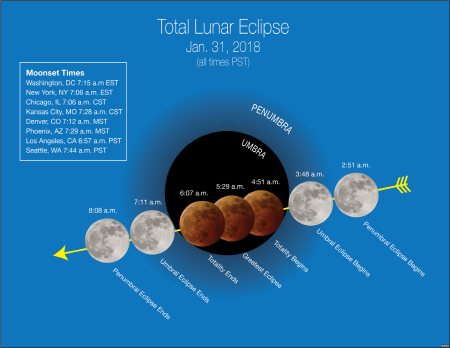
The moon is providing a rare triple treat this week. On Wednesday, much of the world will get to see not only a blue moon and a “supermoon,” but also a total lunar eclipse. Having all three events taking place at the same time is extremely unusual. Astronomers say this has not happened since 1982. And it won’t happen again until 2037. A total lunar eclipse happens when the Earth comes between the Sun and a full moon. The Earth blocks the sun’s light, making the moon appear dark in the sky. The eclipse will be easiest to see in the western half of the United States and Canada before the moon sets early Wednesday morning. It will also be visible across the Pacific Ocean into East Asia as the moon rises Wednesday night into Thursday. The U.S. East Coast, however, is out of luck. The moon will be setting just as the eclipse gets started. Europe, most of Africa and South America also will miss out. A blue moon is a second full moon in one month. It is rare enough that English speakers use the expression “once in a blue moon” to describe something that does not happen often! A supermoon is a full or new moon. It appears brighter and bigger than usual because the moon is closer to the earth than usual.
* rare = (자주 있는 일이 아니어서) 드문[보기 힘든/희귀한]/ triple = 3배의; 3부로 된, 3자[개]로 이뤄진/ treat = 특별한 것[선물], 대접, 한턱/ total lunar eclipse = 개기 월식(皆旣月蝕)/ take place = 일어나다, 열리다/ astronomer = 천문학자/ visible = (눈에) 보이는 알아볼 수 있는/ out of luck = 운이 없어, 운어 나쁘다/ miss out (on sth) = (참석하지 않음으로써 유익하거나 즐거운 것을) 놓치다/ once in a blue moon = 극히 드물게
In a total lunar eclipse, the Earth covers the moon’s surface with its shadow, giving it a red-like color. For that reason, it is also known as a “blood moon.” Some people are calling this week’s lunar event a “super blue blood moon.” Noah Petro is a scientist with the American space agency NASA. He is calling the lunar event, “the Super Bowl of moons.” No matter the name, it is likely to impress if the skies are clear. As the sun lines up perfectly with the Earth and then the moon for the eclipse, scientists will make observations from a telescope in Hawaii. They are also planning to collect information from NASA’s moon-circling Lunar Reconnaissance Orbiter. Just as last August’s total solar eclipse cooled the Earth’s surface, a lunar eclipse cools the surface of the moon. It’s this sudden cooling — from the heat of direct sunlight to almost a deep freeze — that researchers will be studying.
* surface = 표면, 지면, 수면/ shadow = 그림자/ impress = 깊은 인상을 주다, 감명[감동]을 주다/ line up with ~ = ~와 일렬로 서다/ observation = 관찰, 관측/ telescope = 망원경/ Lunar Reconnaissance Orbiter = 달 탐사선/ deep freeze = 급속 냉동(상태)
|
|