
Global Breaking News - Sunday, October 11, 2026








   |
[Headlines] (HL-과학/기술/교육) Why Can’t Some Planes Fly in Hot Weather?
최고관리자 | 17-06-24 10:41
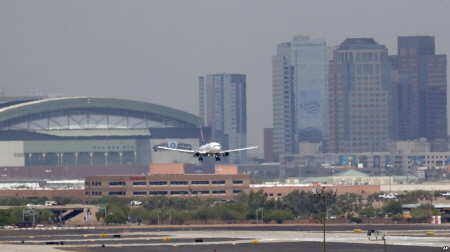
It is sometimes more difficult to get airplanes off the ground in extremely hot weather. But the problem is not the temperature itself or the humidity. It is the air density that can get in the way. Hotter air gets thinner. Thin air makes it more difficult for planes to lift and land safely. This is especially the case with smaller planes. That is why more than 50 flights were canceled in the southwestern United States earlier this week. Temperatures there have climbed to 49 degrees Celsius. Airplanes take off and stay in the air because of lift -- the force from the movement of air under the plane’s wings that push it upward. Lou McNally is a professor of meteorology at Embry-Riddle Aeronautical University. When pilots try to take off in extreme heat the planes sometimes cannot lift before the runway ends. And, when pilots try to land when the air is too thin and hot, they can also run out of runway, McNally said. “As air warms up, it expands and there’s fewer molecules to be under your wing,” he said. With less lift, “you need more of everything. You need more thrust to take off. You need more distance (on the runway) to take off. You need more distance to land. You need more speed to land.”
* get off the ground = 이륙하다/ extremely = 극도로, 극히/ humidity = 습도, 습함, 습기/ air density = 공기 밀도/ get in the way = 방해되다/ climb to ~ = ~까지 오르다/ stay in the air = 체공하다, 상공에 머물다/ lift = 양력(항공기가 비행할 때 밑에서 위로 작용하는 압력)/ meteorology = 기상학/ runway = 활주로/ run out of ~ = ~을 바닥내다, ~이 없어지다/ molecule = 분자/ thrust = 추진력
To fly in high heat, planes must create more power and have larger wings. At Dubai International Airport and other Gulf airports many flights arrive late at night and early in the morning when it is cooler. Gulf airlines also often use larger planes that are not as affected by high heat. In Phoenix, Arizona, though, airlines still use small jets for shorter trips. This week’s extreme heat is rarer there than in Persian Gulf cities. Airlines can take steps to be able to safely fly in extreme heat. One step is to reduce the plane’s weight by selling fewer seats. That is what American Airlines did during the recent Phoenix heat wave. Airlines can also reduce weight by lowering a plane’s fuel level. Then the plane can stop somewhere cooler to refuel and take off again. Before they fly, pilots examine measures of what is called density altitude. These include temperature and humidity. The density altitude is the main issue, but there are other risks that come with flying in hot temperatures. R. J. Hansman, an aeronautics professor at MIT, says the plane’s parts may become too soft or even melt. And pilot Patrick Smith says the plane’s brakes and machinery can overheat. At that point, “things begin to break down,” he said.
* affect = 영향을 미치다/ rare = 드문[보기 힘든/희귀한]/ take steps = 조치를 취하다/ heat wave = 폭염, 혹서/ refule = 연료를 재급유하다/ measure = (치수・양・정도를 나타내는) 단위; 도량법/ what is called = 소위, 이른바/ density altitude = 밀도 고도(密度高度)/ come with ~ = ~이 함께 하다, ~이 따르다/ aeronautics = 항공학, 항공술/ overheat = 과열되다[하다]/ break down = 고장 나다
|
|