[전문 + mp3] / [받아쓰기]
Suzanne Meyer, the assistant director of the English Language Institute at the University of Tennessee, Knoxville, says that many students need to develop critical thinking skills. In other words, students need to learn how to collect information, and then evaluate the information and apply it to a new context. She says: "We need to get students actively engaged in inquiry, from the beginning levels on, into those levels where they really are close to professional and university contexts." One way to develop critical thinking skills, Meyer says, is to teach students to be creative about the types of questions that they ask. Meyer says that there are many benefits to using question-asking activities with English learners. Question-asking activities help students to become better language learners. She says: "Question-asking overall helps students be better language learners. Not for the obvious, because you ask a question you get an answer. Often, questions are the first point of contact. And so if my question is not good, then that's going to direct the level of our conversation."
* critical thinking = 비판적 사고/ in other words = 다시 말해서/ evaluate = 평가하다/ apply = 적용하다/ context = (어떤 일의) 맥락, 전후 사정; (글의) 맥락, 문맥/ engage in ~ = ~에 관여[참여]하게 하다/ inquiry = 연구, 탐구; 조사/ overall = 종합[전반]적으로/ point of contact = (어떤 조직체와 관련된 일을 볼 때) 찾는[접촉하는] 곳[사람]
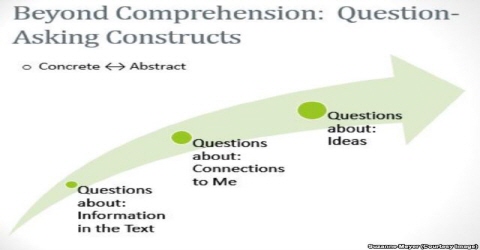
Meyer also says that question-asking may help develop critical thinking skills by allowing for more interactions: "People who can ask questions are very confident. And when you are confident, you can have more interaction. That extra interaction might lead to critical thinking. Because you are more likely to actually integrate in some fashion into a new setting if you are in an ESL scenario. So, I think overall, just the whole question-asking idea has so many benefits." There are many strategies to improve question-asking and develop critical thinking skills. One possible strategy, says Meyer, is to use question-asking patterns that start with concrete questions and move to abstract questions. So, for example, if students were reading a new text, they would design a series of questions using three different steps. In the first step, students create questions about information in the text that they are reading. In the second step, students create questions about how the information in the text connects to their own life. In the third step, students create questions about abstract ideas – ideas that came up in the questions about themselves. If students follow these three steps, they have not only practiced creative ways to ask questions, they have also started practicing critical thinking.
* allow for ~ = ~을 감안하다[참작하다]/ interaction = 상호 작용/ confident = 자신감 있는, 확신하는/ lead to ~ = ~로 이어지다/ integrate into[with] ~ = ~로 통합되다/ in some fashion = 어느 정도/ concrete = 사실에 의거한, 구체적인/ abstract = 추상적인, 관념적인/ connect to[with] ~ = ~와 관련시키다[연결하다]