
Global Breaking News - Friday, September 25, 2026








 |

단순 현재 시제(Simple Present Tense)
영어의 기본 시제는 단 3가지(과거/현재/미래)입니다. 여기에 각각 "완료/진행"이 붙으면 모두 12개 입니다.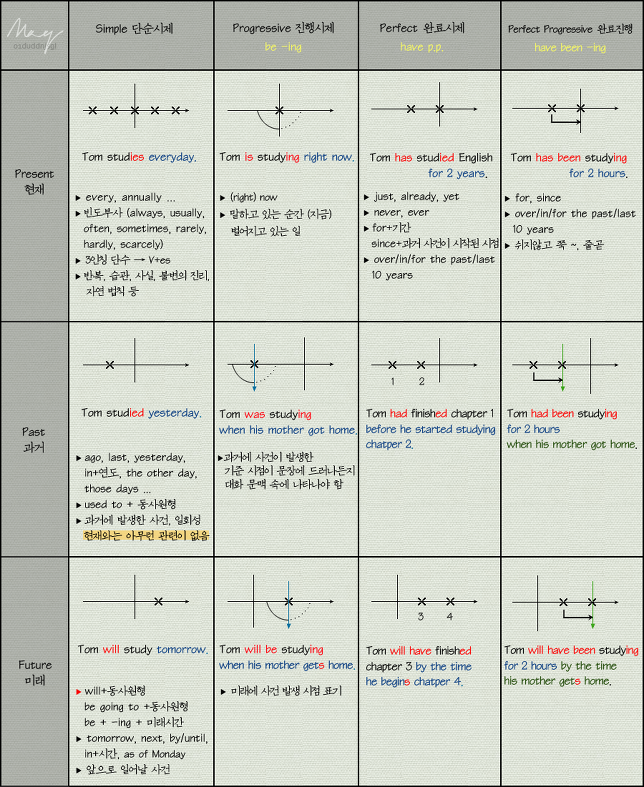
그 첫번째 [단순 Simple 시제를]보겠습니다.
1. 단순시제의 의미
과거 / 현재 / 미래 한 시점에 "일어난/ 일어나는/ 일어날" 내용을 담습니다.
2. 단순시제의 형태 및 예
예) I sing / I dance
*주어가 삼인칭+단수+현재 인 경우에는 동사에s를 붙인다.
예) He sings. / He dances.
3. 부정문 및 의문문
부정문- do not + 동사원형
예) I do not sing.
의문문- Do 주어 + 동사원형
예) Do I sing?
*주어가 삼인칭+단수+현재 인 경우에는 does를 쓴다
예) He does not sing. / Does he dance?
4. 단순 현재의 쓰임
단순현재시제는 다음과 같이 쓰인다.
1) 현재의 반복되는 동작과 상태
ex) He goes to school at 8:00.
He is a student.
2) 현재의 습관과 버릇
ex) I get up at 5:30 and go swimming at 6:00 every morning.
3) 시간을 초월한 일반적 사실, 진리, 격언
ex) The sun rises in the east and sets in the west.
(해는 동쪽에서 떠서 서쪽으로 진다.)
4) 상태 동사(be, have, hear, see, etc.)는 현재 시제로 쓰여서 말하고 있는 시점을 표현한다.
ex) I smell gas.
Do you see that green bird near the stream?
◑ 시간/조건절 ◑
시간부사절(when, after, as soon as, before, by the time)과 조건부사절(if, unless)에서는 현재가
미래를 대신하므로 미래 시제 대신 현재 시제를, 그리고 미래완료 시제 대신 현재완료시제를 써야 한다.
ex) We'll go home when the rain will stop.(×)
→ We'll go home when the rain stops.
You'll feel a lot better after you've had a rest.
※ 주의
(a) 명사절과 관계 대명사절에서는 미래 시제를 쓴다.
ex) I don't know when she will go home.(간접의문문-명사절)
(b) 조건절에 will/would(=wish)가 쓰여 주어의 소망이나 의지를 나타낼 수 있다.
ex) Everything will be all right if you will all do as you are told.
◑ 미래◑
미래 시제는 다음과 같이 나타낼 수 있다.
1) will, shall: 단순미래와 의지미래에 쓰인다.
ex) I'll be twenty-four in June.
2) 단순현재시제: 왕래 발착동사(go, come, start, depart, arrive, run)가 시간부사와 함께 쓰여 가까운 미래를
나타낸다.
ex) I start for Italy next Monday.
3) be going to do: 현재가 원인이 되거나 주어의 의지로 미래에 행위가 발생할 때 쓴다.
ex) It is going to snow in the afternoon. Look at those black clouds.
(오후에 눈이 올 것이다. 저 먹구름들 좀 봐라.)
When are you going to get married?
4) 진행형: 진행형을 사용하여 가까운 미래에 일어날 일을 표현한다.
ex) I'm taking the children to the zoo on Sunday.
5) 기타: be about to, be willing to, be likely to, be to 등이 있다.
ex) We were about to start, when it began to rain.
◑ 과거◑
과거의 일회성 동작이나 일시적인 상태를 나타내는 경우에 쓰인다.
1) 단순 과거사실: 과거 발생한 일을 말할 때 쓰인다.
ex) I heard the news an hour ago.
She studied music while she was in Paris.
2) 과거의 습관: 주로 빈도부사(always often 등), 경험 표시 부사(once, before 등)와 함께 쓰여 과거의 일시적인
습관을 나타낸다.
ex) He wanted a room of his own.
※ 주의 used to(과거의 규칙적인 습관이나 상태)와 would(과거의 불규칙적인 습관)는 빈도 부사가 없어도 습관을
나타낼 수 있다.
ex) I used to go to the cinema a lot, but I haven't got much time these days.
When we worked in the same office, we would (often) have coffee together.
◑ 진행◑
동작 동사가 일정 기간 동안 진행될 때 쓴다.
1) 진행되고 있는 시점에 따라서 현재진행, 과거진행, 미래진행 시제로 분류된다.
ex) The room is getting dark.
What were you doing at seven p.m. yesterday?
He will be lecturing on the romantic poets tomorrow.
2) 과거 시점에 시작된 행동이 바로 그 시점에도 계속되고 있으면 완료 진행 시제를 쓴다.
시점에 따라서 현재 완료 진행, 과거 완료 진행, 그리고 미래 완료 진행 시제로 불린다.
ex) We've been learning this language for ten years.
I'll have been teaching for twenty years this summer.
We realized we had been living too expensively.
3) 진행형으로 할 수 없는 동사:
(1) 감정, 심리 동사 : like, hate. love etc.
(2) 감각, 지각 동사 : hear, see, feel, smell, look etc.
(3) 소속, 소유 동사 : belong, have, consist etc.
(4) 기타 : know, remember, think, resemble, want etc.
ex) Look at this picture. It is belonging to me.(×)
→ Look at this picture. It belongs to me.
※ 주의 진행형으로 할 수 없는 동사들도 동작을 의미할 경우는 진행 시제로 쓸 수 있다.
ex) The director is seeing the applicants this morning.
(see는 "보이다"의 뜻이 아니라 "면접하다"의 뜻으로 쓰이고 있다.)
◑ 현재완료◑
과거에 시작된 동작이 현재까지 지속되고 있을 때 완료시제를 쓴다.
상황에 따라서 "완료, 경험, 계속, 결과"의 의미를 갖는다.
ex) I have just finished my dinner.(완료)
I've cut me my finger.(결과)
-손가락을 베어 아직도 피가 흐르고 있거나, 상처가 아물지 않고 있다.
I have smoked since I left school.(계속)
I have never seen a house as beautiful as this.(경험)
◑ Since◑
since는 "~한 이래"의 뜻으로 다음과 같이 접속사, 전치사, 부사로 쓰인다.
강조하기 위해서 ever since를 쓸 수 있다. 주절에는 완료시제가 온다.
1) 접속사: since절의 동사에는 단순과거시제가 온다.
ex) We've been friends since we met at school.
2) 전치사: 전치사일 때는 원인의 뜻이 아닌 "~한 이래"의 뜻이다.
since의 목적어에는 과 거 한 시점을 나타내는 어구가 와야 한다.
ex) It has not changed since three years.(×)
→ It has not changed since three years ago.
3) 부사: 문장 뒤나 동사 뒤에 위치한다.
ex) The accident happened four years ago and she has not spoken since.
◑ 미래완료시제◑
미래 어느 특정 시점까지의 동작 또는 상태를 의미한다.
ex) I shall have read the book by next week.(완료)
In the 2000, we'll have been married for thirty years.(계속)
I will have read the book three times if I read it again.(경험)
We will have left our home by this time tomorrow.(결과)
◑ 과거완료시제◑
과거 이전에 시작되어 과거 시점까지 행위가 이루어진 것을 의미한다.
ex) Everything went on as I had expected.(대과거)
When we got to the station the train had left.(완료)
John had lived in Paris for ten years when I met him.(계속)
I hadn't met him before.(경험)
He had gone to the United States.(결과)
◑ Last, past◑
1) last + 시간명사: 현재를 기준으로 하여 "지난"의 의미를 갖는다.
과거 한 순간을 나타내므로 항상 과거시제와 쓰인다.
ex) Did you watch the game on TV last night?(= in the night before this)
※ 주의 전치사인 in, at, on, for, during 등과 함께 쓰일 수 없다.
ex) All the bills were paid in last month.(×)
→ All the bills were paid last month.
2) the + last + 시간명사: 과거 한 시점으로부터 말하는 현재의 순간까지 동작이 이어지기때문에
현재완료시제와 쓰인다.
ex) Fashion has changed in the last twenty years.(= for the last twenty years)
3) the + past + 시간명사: "지난"의 의미로 과거 어느 시점으로부터 최근까지 행위가 이어지기 때문에
현재완료시제와 쓰인다.
ex) In the past year, Shane's changed his job three times.
◑ Ago, before◑
1) ago: 현재를 기준으로 하여 과거 한 시점을 말하기 때문에 단순 과거 시제와 쓰인다.
ex) He left Seoul ten minutes ago.(십분 전)
※ 주의 the, this, that 등과 같이 쓰이지 않고 "a/숫자+시간명사+ago"의 형태로 쓰인다.
ex) this ten years ago(×) → ten years ago
cf) It doesn't resemble the one of three years ago.
2) before: 주로 완료시제와 함께 쓰이지만, 현재로부터 정확하게 측정할 수 없는 과거를 표현할 때도 쓰인다.
ex) I've seen that film before.
It has been fine the day before.
Last week she was in paris and week before she was in Rome.
◑ For, in, during ◑
1) for: 시간 명사와 쓰여서 어떤 행위나 상황이 얼마나 오랫동안 지속되는가를 말한다
ex) He's been working for two months.(그는 두 달 동안 일을 하고 있다.)
※ 주의 "for+시간명사"는 단순 현재 시제와 쓰이지 않는다.
ex) He works for the company for ten years.(×)
→ He has worked for the company for ten years.
2) during: 특정한 기간, 시점에 쓰이므로 시간명사 앞에 "the/that/these/those/소유격" 등이 온다.
ex) We didn't see a soul during the holidays.
(공휴일 동안 한 사람도 보지 못했다.)
※ 주의 "숫자+시간명사"에는 쓰이지 않고 대신 for가 쓰인다.
ex) He has been married during twenty years.(×)
→ He has been married for twenty years.
3) in: "in+과거 특정 시간명사"에서 in은 "어떤 기간중 한 시점"(at some time during)을 나타내기 때문에
항상 단순과거 시제와 쓰인다.
ex) For the first time, he visited New York in 1996.
◑ By, until, before, after ◑
1) by: 시간 명사와 쓰이면 `~까지'의 뜻으로 동작의 완료를 나타낸다.
ex) The documents need to be ready by next Friday.
2) until, till: 어느 시점까지의 계속을 나타낸다.
ex) Gary was working for the company until 1995.
3) before: before 다음에 과거 시점이 오면 주절은 과거나 과거완료를 쓴다.
현재 시점이 오면 주절은 미래나 미래완료를 쓴다.
ex) Did she leave a message before she went?
It will be sometime before we know the full results.
The new road should be completed before the end of the year.
4) after: after 다음에 과거/과거완료 시점이 오면 주절은 과거 시제를 쓰고, 현재/현재완료 시제가 오면
주절은 미래 시제를 쓴다.
ex) What did you do after you had called the police?
You'll feel a lot better after you've had a rest.
◑ 불규칙동사 ◑
불규칙 동사는 시험에 자주 출제되므로 암기해야 한다.
find-found-found beat-beat-beaten
break-broke-broken choose-chose-chosen
wear-wore-worn freeze-froze-frozen
hide-hid-hidden tear-tore-torn
burst-burst-burst cost-cost-cost
hurt-hurt-hurt cut-cut-cut
let-let-let put-put-put
set-set-set shut-shut-shut
spread-spread-spread hit-hit-hit
ex) Several people were seriously hurted in the accident.(×)
→ Several people were seriously hurt in the accident.
◑ 시제일치◑
주절의 동사가 과거 시제이면 종속절의 시제는 내용에 따라서 과거나 과거완료가 된다.
ex) I told you that the road was closed.
He told us that the bridge had collapsed.
※ 주의 다음은 시제를 일치시키지 않는다.
1) 불변의 진리, 일반적 사실, 현재의 습관
ex) We learned at school that 2 and 2 is 4.
2) 가정법 과거, 가정법 과거완료, 가정법 미래
ex) He said, "If my children were older I would emigrate."
He said that if his children were older he would emigrate.
|
|